
Code to Career: Brand Identity
The Challenge
When Canada Learning Code and BrainStation secured a $10M funding award through Upskill Canada, powered by Palette Skills and the Government of Canada, the mandate was clear: deliver a national software engineering training program that would reach 800 underrepresented people in Canada from coast to coast to coast.
The program had a name. It had funding. It had two established organizational brands behind it. What it needed was a cohesive identity that could represent the communities it was built to serve; authentically, not tokenistically, and a launch strategy that would give it national presence and credibility from day one.

My Role
As Director of Marketing & Communications at Canada Learning Code, the funded entity in the partnership, I led the brand development process in close collaboration with my counterpart at BrainStation, whose internal creative team executed the work. I also managed a national PR campaign to launch the program across eight Canadian cities, working with a PR firm, government representatives, corporate supporters, and the CEOs of both organizations to bring Code to Career to communities across the country.
The
Approach
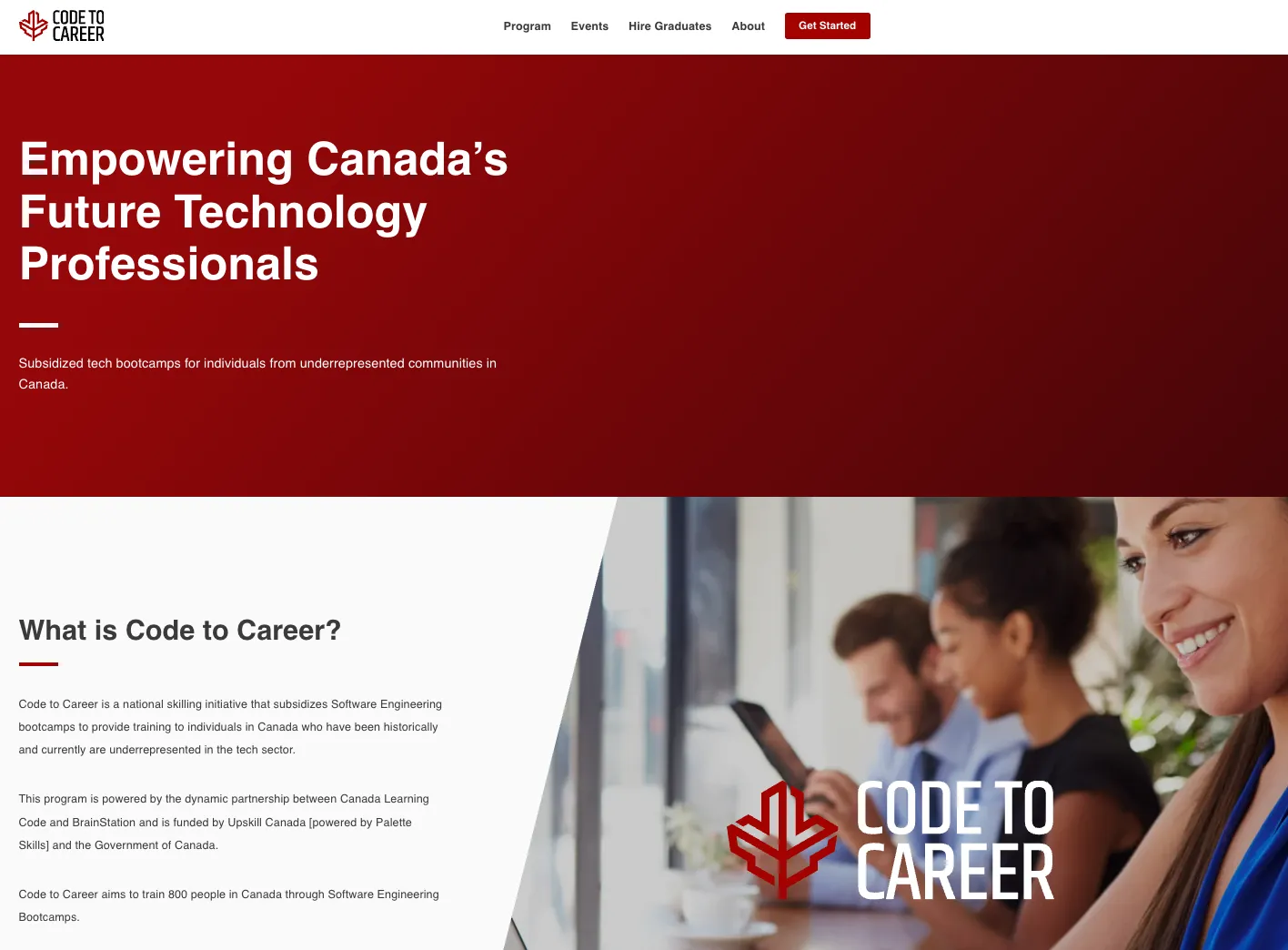
Code to Career was built as a true co-brand: “Canada Learning Code and BrainStation have come together to bring Code to Career to communities across the country”, with visibility requirements for the Government of Canada and Palette Skills as funding partners. Navigating that brand hierarchy while maintaining a coherent, audience-facing identity was a core part of the strategic work.
The visual identity and language were developed through a consultative process informed by Canada Learning Code’s deep understanding of the communities the program was designed to reach: women, transgender and non-binary individuals, racialized people, and individuals from Indigenous communities across Canada.
That consultation shaped every creative decision. Imagery needed to reflect the full breadth of the target audience, not a token gesture toward diversity, but genuine, intentional representation of the people this program existed to serve. Language needed to be inclusive and accessible without being patronizing. The result was a brand that felt credible to funders and government partners while remaining approachable and relevant to the individuals it was trying to reach.
The
Launch
With the brand in place, the focus shifted to national launch. I managed a rolling PR campaign across eight cities over six months; Toronto, Ottawa, Halifax, St. John’s, Victoria, Vancouver, Sudbury, and Saskatoon, coordinating kick-off events that brought together provincial government representatives, corporate supporters, and community stakeholders.
Working with a PR firm, I managed government invitations and briefing notes for each city. Corporate invitations were sourced through the networks of both organizations’ CEOs and broader stakeholder relationships. Each event was tailored to its local context while maintaining consistent national messaging, no small feat across eight cities with multiple organizational partners and government visibility requirements.


The Outcome
The brand built for this program held up across an ambitious national rollout, eight cities, multiple institutional partners, and a target audience that had every reason to be skeptical of programs that claimed to be built for them.
Ready to talk about what a brand built for the long term could look like for yours?